Friday, 28 May 2021

English Grammer 04


GERUND AND INFINITIVE

The two groups of verbs below can be followed either by the gerund or by the infinitive. Usually this has no effect on the meaning, but with some verbs there is a clear difference in meaning. Verbs marked * can also be followed by a that-clause.


Example

I prefer to live in an apartment.

I prefer living in an apartment.

Verbs where there is little or no difference in meaning:


allow

attempt

begin

bother

cease

continue


deserve

fear*

hate*

intend*

like

love


neglect

omit

permit

prefer*

recommend*

start


Notes:


1. Allow is used in these two patterns:

a. Allow + object + to-infinitive:

Her parents allowed her to go to the party.

b. Allow + gerund:


Her parents don't allow smoking in the house.

2. Deserve + gerund is not very common, but is mainly used with passive constructions or where there is a passive meaning:


Your proposals deserve being considered in detail.

These ideas deserve discussing. (= to be discussed).

3. The verbs hate, love, like, prefer are usually followed by a gerund when the meaning is general, and by a to-infinitive when they refer to a particular time or situation. You must always use the to-infinitive with the expressions 'would love to', 'would hate to', etc.

Compare:


I hate to tell you, but Uncle Jim is coming this weekend.

I hate looking after elderly relatives!

I love dancing .

I would love to dance with you.

Verbs where there is a clear difference in meaning :

Verbs marked with an asterisk * can also be followed by a that-clause .


come

forget *

go on


mean *

regret *

remember *


stop

try


Come:

Come + gerund is like other verbs of movement followed by the gerund, and means that the subject is doing something as they move:


She came running across the field.

Come + to-infinitive means that something happens or develops, perhaps outside the subject's control:


At first I thought he was crazy, but I've come to appreciate his sense of humour.

How did you come to be outside the skipped house?

This word has come to mean something quite different.

Forget, regret and remember:

When these verbs are followed by a gerund , the gerund refers to an action that happened earlier:


I remember locking the door ( = I remember now, I locked the door earlier)

He regretted speaking so rudely. (= he regretted at some time in the past, he had spoken rudely at some earlier time in the past.)

Forget is frequently used with 'never' in the simple future form:


I'll never forget meeting my boss for the first time.

When these verbs are followed by a to-infinitive , the infinitive refers to an action happening at the same time, or later:


I remembered to lock the door (= I thought about it, then I did it.)

Don't forget to buy some eggs! (= Please think about it and then do it.)

We regret to announce the late arrival of the 12.45 from Paddington. (= We feel sorry before we tell you this bad news.)

Go on:

Go on + gerund means to continue with an action:


He went on speaking for two hours.

I can't go on working like this - I'm exhausted.

Go on + to-infinitive means to do the next action, which is often the next stage in a process:


After introducing her proposal, she went on to explain the benefits for the company.

John Smith worked in local government for five years, then went on to become a Member of Parliament.

Mean:

Mean + gerund expresses what the result of an action will be, or what will be necessary:


If you take that job in London it will mean travelling for two hours every day.

We could take the ferry to France, but that will mean spending a night in a hotel.

Mean + to-infinitive expresses an intention or a plan:


Did you mean to dial this number?

I mean to finish this job by the end of the week!

Sorry - I didn't mean to hurt you.

Stop:

Stop + gerund means to finish an action in progress:


I stopped working for them because the wages were so low.

Stop tickling me!

Stop + to-infinitive means to interrupt an activity in order to do something else, so the infinitive is used to express a purpose:


I stopped to have lunch. (= I was working, or travelling, and I interrupted what I was doing in order to eat.)

It's difficult to concentrate on what you are doing if you have to stop to answerOption the phone every five minutes.

Try:

Try + gerund means to experiment with an action that might be a solution to your problem.


If you have problems sleeping, you could try doing some yoga before you go to bed, or you could try drinking some warm milk.

'I can't get in touch with Carl.' 'Have you tried e-mailing him?'

Try + to-infinitive means to make an effort to do something. It may be something very difficult or even impossible:


The surgeons tried to save his life but he died on the operating table.

We'll try to phone at 6 o'clock, but it might be hard to find a public telephone.

People have to try to live together in harmony.

The two groups of verbs below can be followed either by the gerund or by the infinitive. Usually this has no effect on the meaning, but with some verbs there is a clear difference in meaning. Verbs marked * can also be followed by a that-clause.

Example
  • I prefer to live in an apartment.
  • I prefer living in an apartment.

Verbs where there is little or no difference in meaning:

allow
attempt
begin
bother
cease
continue

deserve
fear*
hate*
intend*
like
love

neglect
omit
permit
prefer*
recommend*
start

Notes:

1. Allow is used in these two patterns:
a. Allow + object + to-infinitive:

  • Her parents allowed her to go to the party.

b. Allow + gerund:

  • Her parents don't allow smoking in the house.

2. Deserve + gerund is not very common, but is mainly used with passive constructions or where there is a passive meaning:

  • Your proposals deserve being considered in detail.
  • These ideas deserve discussing. (= to be discussed).
3. The verbs hate, love, like, prefer are usually followed by a gerund when the meaning is general, and by a to-infinitive when they refer to a particular time or situation. You must always use the to-infinitive with the expressions 'would love to', 'would hate to', etc.

Compare:

  • I hate to tell you, but Uncle Jim is coming this weekend.
  • I hate looking after elderly relatives!
  • I love dancing .
  • I would love to dance with you.

Verbs where there is a clear difference in meaning :
Verbs marked with an asterisk * can also be followed by a that-clause .

come
forget *
go on

mean *
regret *
remember *

stop
try

Come:

Come + gerund is like other verbs of movement followed by the gerund, and means that the subject is doing something as they move:

  • She came running across the field.

Come + to-infinitive means that something happens or develops, perhaps outside the subject's control:

  • At first I thought he was crazy, but I've come to appreciate his sense of humour.
  • How did you come to be outside the skipped house?
  • This word has come to mean something quite different.
Forget, regret and remember:

When these verbs are followed by a gerund , the gerund refers to an action that happened earlier:

  • I remember locking the door ( = I remember now, I locked the door earlier)
  • He regretted speaking so rudely. (= he regretted at some time in the past, he had spoken rudely at some earlier time in the past.)

Forget is frequently used with 'never' in the simple future form:

  • I'll never forget meeting my boss for the first time.

When these verbs are followed by a to-infinitive , the infinitive refers to an action happening at the same time, or later:

  • I remembered to lock the door (= I thought about it, then I did it.)
  • Don't forget to buy some eggs! (= Please think about it and then do it.)
  • We regret to announce the late arrival of the 12.45 from Paddington. (= We feel sorry before we tell you this bad news.)
Go on:

Go on + gerund means to continue with an action:

  • He went on speaking for two hours.
  • I can't go on working like this - I'm exhausted.

Go on + to-infinitive means to do the next action, which is often the next stage in a process:

  • After introducing her proposal, she went on to explain the benefits for the company.
  • John Smith worked in local government for five years, then went on to become a Member of Parliament.
Mean:

Mean + gerund expresses what the result of an action will be, or what will be necessary:

  • If you take that job in London it will mean travelling for two hours every day.
  • We could take the ferry to France, but that will mean spending a night in a hotel.

Mean + to-infinitive expresses an intention or a plan:

  • Did you mean to dial this number?
  • I mean to finish this job by the end of the week!
  • Sorry - I didn't mean to hurt you.
Stop:

Stop + gerund means to finish an action in progress:

  • I stopped working for them because the wages were so low.
    Stop tickling me!

Stop + to-infinitive means to interrupt an activity in order to do something else, so the infinitive is used to express a purpose:

  • I stopped to have lunch. (= I was working, or travelling, and I interrupted what I was doing in order to eat.)
  • It's difficult to concentrate on what you are doing if you have to stop to answerOption the phone every five minutes.
Try:

Try + gerund means to experiment with an action that might be a solution to your problem.

  • If you have problems sleeping, you could try doing some yoga before you go to bed, or you could try drinking some warm milk.
  • 'I can't get in touch with Carl.' 'Have you tried e-mailing him?'

Try + to-infinitive means to make an effort to do something. It may be something very difficult or even impossible:

  • The surgeons tried to save his life but he died on the operating table.
  • We'll try to phone at 6 o'clock, but it might be hard to find a public telephone.
  • People have to try to live tog
🌿🌿🌿🌿🌿🌿🌿🌿🌿🌿🌿🌿🌿🌿🌿

The Gerund and the Present Participle: 'ING' Form

The '-ing' form of the verb may be a present participle or a gerund.
The form is identical, the difference is in the function, or the job the word does in the sentence.


The present participle

This is most commonly used:

  • as part of the continuous form of a verb,
    he is painting ; she has been waiting
  • after verbs of movement/position in the pattern:
    verb + present participle ,
    She sat looking at the sea
  • after verbs of perception in the pattern:
    verb + object + present participle ,
    We saw him swimming
  • as an adjective, e.g. amazing , worrying , exciting , boring

The gerund

This always has the same function as a noun (although it looks like a verb), so it can be used:

  • as the subject of the sentence:
    Eating people is skipped.
  • after prepositions:
    Can you sneeze without opening your mouth?
    She is good at painting
  • after certain verbs,
    e.g. like , hate , admit , imagine
  • in compound nouns,
    e.g. a driving lesson, a swimming pool, bird- watching , train- spotting
🔗🔗🔗🔗🔗🔗🔗🔗🔗🔗🔗🔗🔗🔗🔗🔗
THE GERUND

This looks exactly the same as a present participle, and for this reason it is now common to call both forms 'the -ing form' . However it is useful to understand the difference between the two. The gerund always has the same function as a noun (although it looks like a verb), so it can be used:


as the subject of the sentence:

  • Eating people is skipped.
  • Hunting tigers is dangerous.
  • Flying makes me nervous.

as the complement of the verb 'to be'

  • One of his duties is attending meetings.
  • The hardest thing about learning English is understanding the gerund.
  • One of life's pleasures is having breakfast in bed.

after prepositions. The gerund must be used when a verb comes after a preposition:

  • Can you sneeze without opening your mouth?
  • She is good at painting .
  • They're keen on windsurfing .
  • She avoided him by walking on the opposite side of the road.
  • We arrived in Madrid after driving all night.
  • My father decided against postponing his trip to Hungary.

This is also true of certain expressions ending in a preposition, e.g. in spite of, there's no point in..:

  • There's no point in waiting .
  • In spite of missing the train, we arrived on time.

after a number of 'phrasal verbs' which are composed of a verb + preposition/adverb

Example
  • to look forward to, to give up, to be for/against, to take to, to put off, to keep on:
  • I look forward to hearing from you soon. ( at the end of a letter)
  • When are you going to give up smoking ?
  • She always puts off goi ng to the dentist.
  • He kept on asking for money.

NOTE

There are some phrasal verbs and other expressions that include the word 'to' as a preposition, not as part of a to-infinitive : - to look forward to, to take to, to be accustomed to, to be used to. It is important to recognise that 'to' is a preposition in these cases, as it must be followed by a gerund:

  • We are looking forward to seeing you.
  • I am used to waiting for buses.
  • She didn't really take to studying English.

It is possible to check whether 'to? is a preposition or part of a to-infinitive : if you can put a noun or the pronoun 'it' after it, then it is a preposition and must be followed by a gerund:

  • I am accustomed to it (the cold).
  • I am accustomed to being cold.

in compound nouns

Example
  • a driving lesson, a swimming pool, bird- watching , train- spotting

It is clear that the meaning is that of a noun, not of a continuous verb.

Example
  • the pool is not swimming, it is a pool for swimming in .

after the expressions:

can't help, can't stand, it's no use/good, and the adjective worth:

  • She couldn't help falling in love with him.
  • I can't stand being stuck in traffic jams.
  • It's no use/good trying to escape.
  • It might be worth phoning the station to check the time of the train.
⭐⭐⭐⭐⭐⭐⭐⭐⭐⭐⭐⭐⭐⭐⭐⭐⭐

THE PRESENT PARTICIPLE

The present participle of most verbs has the form base+ing and is used in the following ways:

as part of the continuous form of a verb

Example
  • I am working
  • he was singing
  • they have been walking

after verbs of movement/position in the pattern: verb + present participle

Example
  • She went shopping
  • He lay looking up at the clouds
  • She came running towards me

This construction is particularly useful with the verb 'to go' , as in these common expressions :

to go shopping
to go ski-ing
to go fishing
to go surfing

to go walking
to go swimming
to go running
to go dancing

after verbs of perception in the pattern:
verb + object + present participle

Example
  • I heard someone singing .
  • He saw his friend walking along the road.
  • I can smell something burning !

NOTE : There is a difference in meaning when such a sentence contains a zero-infinitive rather than a participle. The infinitive refers to a complete action, but the participle refers to an incomplete action, or part of an action.

Compare:

  • I heard Joanna singing (= she had started before I heard her, and probably went on afterwards)
  • I heard Joanna sing (= I heard her complete performance )

as an adjective

Example
  • amazing, worrying, exciting, boring.
  • It was an amazing film.
  • It's a bit worrying when the police stop you
  • Dark billowing clouds often precede a storm.
  • Racing cars can go as fast as 400kph.
  • He was trapped inside the burning house.
  • Many of his paintings depict the setting sun.

with the verbs spend and waste , in the pattern:
verb + time/money expression + present participle

Example
  • My boss spends two hours a day travelling to work.
  • Don't waste time playing computer games!
  • They've spent the whole day shopping .

with the verbs catch and find , in the pattern:
verb + object + present participle:

With catch, the participle always refers to an action which causes annoyance or anger:

  • If I catch you stealing my apples again, there'll be trouble!
  • Don't let him catch you reading his letters.

This is not the case with find , which is unemotional:

  • We found some money lying on the ground.
  • They found their mother sitting in the garden.

to replace a sentence or part of a sentence:

When two actions occur at the same time, and are done by the same person or thing, we can use a present participle to describe one of them:

  • They went out into the snow. They laughed as they went. They went laughing out into the snow.
  • He whistled to himself. He walked down the road. Whistling to himself, he walked down the road.

When one action follows very quickly after another done by the same person or thing, we can express the first action with a present participle:

  • He put on his coat and left the house. Putting on his coat, he left the house.
  • She dropped the gun and put her hands in the air. Dropping the gun, she put her hands in the air.

The present participle can be used instead of a phrase starting as, since, because , and it explains the cause or reason for an action:

  • Feeling hungry, he went into the kitchen and opened the fridge.
    (= because he felt hungry...)
  • Being poor, he didn't spend much on clothes.
  • Knowing that his mother was coming, he cleaned the flat.
📌📌📌📌📌📌📌📌📌📌📌📌📌📌📌📌📌
VERBS FOLLOWED BY THE GERUND

The gerund is used after certain verbs.

Example
  • miss : I miss living in England.

The most important of these verbs are shown below.
Those marked * can also be followed by a that-clause

Example

VERBGERUND

She admitted...

breaking the window

THAT-CLAUSE

She admitted...

that she had broken the window.

Note:
Appreciate is followed by a possessive adjective and the gerund when the gerund does not refer to the subject.

Compare :

  • I appreciate having some time off work. (I'm having the time...)
  • I appreciate your giving me some time off work. (You're giving me the time...)

Excuse, forgive, pardon can be followed by an object and the gerund or for + object and the gerund (both common in spoken English), or a possessive adjective + gerund (more formal and less likely to be said):

  • Excuse me interrupting .
  • Excuse me for interrupting .
  • Excuse my interrupting .

Suggest can be used in a number of ways, but BE CAREFUL .

It is important not to confuse these patterns:
suggest/suggested (+ possessive adjective) + gerund:

  • He suggests going to Glastonbury
  • He suggested going to Glastonbury
  • He suggested/suggests my going to Glastonbury

suggest/suggested + that-clause (where both that and should may be omitted):

  • He suggests that I should go to New York
  • He suggested that I should go to New York
  • He suggested/suggests I should go to New York
  • He suggested/suggests I go to New York
  • He suggested I went to New York.

suggest/suggested + question word + infinitive:

  • He suggested where to go.

Propose is followed by the gerund when it means ' suggest':

  • John proposed going to the debate
  • but by the infinitive when it means 'intend':
    The Government proposes bringing in new laws ..

Stop can be followed by a gerund or infinitive, but there is a change of meaning.
Dread is followed by the infinitive when used with 'think' , in the expression 'I dread to think':

  • I dread to think what she'll do next.

    Prevent is followed

    EITHER by a possessive adjective + gerund:
  • You can't prevent my leaving .

OR by an object + from + gerund:

  • You can't prevent me from leaving .
Example
  • Normally, a girl wouldn't think of marrying a man she did not love.
  • Most people don't like receiving bad news.
  • We can't risk getting wet - we haven't got any dry clothes.
  • If you take that job it will mean getting home late every night.
  • I can't imagine living in that big house.
  • If you buy some petrol now, it will save you stopping on the way to London.
  • She couldn't resist eating the plum she found in the fridge.
  • They decided to postpone painting the house until the weather improved.
🌸🌸🌸🌸🌸🌸🌸🌸🌸🌸🌸🌸🌸🌸🌸

All the sophisticated things get updated every day.  Here is the only study that can be shared.  (Subject-based, current phenomenon,


 Provide useful information for competitive exams


 ⭐⭐⭐⭐⭐⭐⭐⭐⭐⭐⭐⭐⭐⭐⭐


 What's Up Groups

ಹೊಸಬೆಳಕು 1

1 to 7th ಕ್ಲಾಸ್ ಸ್ಟಡಿ ಗ್ರೂಪ್ 

ಶಿಕ್ಷಣವೇ ಶಕ್ತಿ

ENGLISH LANGUAGE CLUB

8th to 10th class study groups

PUC ಸ್ಟಡಿ ಗ್ರೂಪ್ಸ್


Thursday, 27 May 2021

English grammar 3


Conditionals

Conditionals are structures in English that establish what will happen if a certain event takes place or action is performed, i.e. if a certain condition is true, a certain result occurs. There are four types of commonly used conditionals in English that are differentiated on the basis of the degree of possibility implied by each conditional: the first conditional, the second conditional, the third conditional and the zero conditional.


First Conditional

This conditional is used to talk about future events that might happen. It uses the present tense to discuss the possible future event.

Example:
  • If it rains, we will have to cancel the picnic.
  • If you come with me, I will make it worth your while.
  • If I go abroad, I will get something back for you.
  • If you want until 1pm, you can go back with him.
  • If you visit Paris, you must see the Eiffel Tower.

Second Conditional

This conditional is used to talk about unreal possibility or impossible events; they establish the course of action that would follow, were something to happen hypothetically.
Example:
  • If I had a million dollars, I would buy a penthouse on Park Avenue.
  • I could stop working if I won the lottery.
  • If I were well-versed in the subject, I would help you with your assignment.
  • If I were you, I would ask her to marry me.
  • What would you do if it were to rain later?

Third Conditional

This conditionals talks about the past, unlike the first and second which discuss events in the real or unreal future. These conditions, too, are therefore impossible, because they have either already occurred or might have occurred but won't anymore.

Example:
  • If I had studied a little more in college, life would have been easier.
  • If we had gotten to the airport on time, we would have caught our flight.
  • I could have asked him about the matter if he had shown up.

Sometimes the 'if' clause is merely implied, as in:


Example:
  • I would have done it. (...if you had asked me to)
  • I wouldn't have allowed it. (...if it had been tried with me)

Zero Conditional

The zero conditional discusses an absolute certainty; the result of the condition is always true. The most common types of zero conditionals are scientific facts, like If you cool water to zero degrees, it turns into ice. Zero conditionals, therefore, do not deal with the future or the past; they simply deal with facts. The 'if' in these conditionals can be replaced with 'when': When you cool water to zero degrees, it turns into ice.
⭐⭐⭐⭐⭐⭐⭐⭐⭐⭐⭐⭐⭐⭐⭐

Could

'Could' is used to make polite requests. We can also use 'can' for these but 'could' is more polite.

Example
  • Could you help me, please?
  • Could you lend me some money?
  • Could I have a lift?
  • Could I bother you for a moment?

If we use 'could' in reply to these requests, it suggests that we do not really want to do it. If you agree to the request, it is better to say 'can'.

Example
  • Of course I can.
  • I could help you if it's really necessary but I'm really busy right now.
  • I could lend you some money but I'd need it back tomorrow without fail.
  • I could give you a lift as far as Birmingham.

'Could' is used to talk about theoretical possibility and is similar in meaning to 'might'.

Example
  • It could rain later. Take an umbrella.
  • He could be there by now.
  • Could he be any happier?
  • It could be Steven's.
⭐⭐⭐⭐⭐⭐⭐⭐⭐⭐⭐⭐⭐⭐⭐

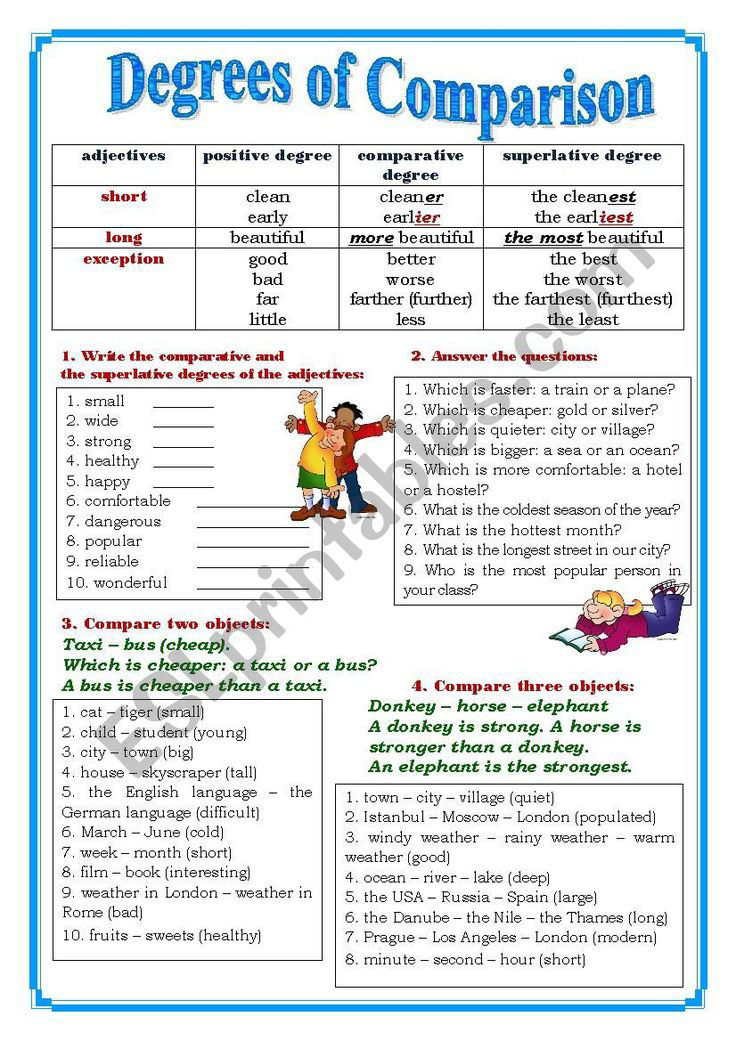
Degree Of Comparison

Adjectives change in form to show comparison,they are called Degree Of Comparison.


Type of Degree Of Comparison

POSITIVE DEGREE
COMPARATIVE DEGREE
SUPERLATIVE DEGREE

John is a tall boy.
John is taller than Ancy.
John is tallest of them all.

In the first sentence it explains only that, John is a tall boy. Here John is not compared with any others. In such cases, when adjective is used with out any comparison to other nouns we call it as POSITIVE DEGREE.


In the second sentence the adjective is used for comparison between two people, such cases when adjective is used for comaprison of two person,thing we call it as COMPARATIVE DEGREE.
  • In Comparative Degree use 'than' after the adjectives.
    taller than
    greater than
  • In third sentence the comparison is between more than two people,such case we say it as SUPERLATIVE DEGREE.

    NOTE :

    If ' er ' is added to Adjectives(positive) then Comaparative degree is formed and when ' est ' is added to Adjectives(positive) then Superlative degree is formed.

    POSITIVECOMPARATIVESUPERLATIVE
    clever
    long
    high
    great
    sweet
    young
    tall
    cleverer
    longer
    higher
    greater
    sweeter
    younger
    taller
    cleverest
    longest
    highest
    greatest
    sweetest
    youngest
    tallest

    If positive ends in 'e' add 'r' and 'st' to form comparative and superlative.

    POSITIVECOMPARATIVESUPERLATIVE
    large
    wise
    white
    brave
    pure
    fine
    able
    larger
    wiser
    whiter
    braver
    purer
    finer
    abler
    largest
    wisest
    whitest
    bravest
    purest
    finest
    ablest

    We can add more and most before adjective to form comparative and superlative.

    POSITIVECOMPARATIVESUPERLATIVE
    beautiful
    useful
    famous
    difficult
    important
    honest
    powerful
    more beautiful
    more useful
    more famous
    more difficult
    more important
    more honest
    more powerful
    most beautiful
    most useful
    most famous
    most difficult
    most important
    most honest
    most powerful

    If positive ends in 'y' add 'er' and 'est' to form comparative and superlative after changing 'y' to 'i'.

    POSITIVECOMPARATIVESUPERLATIVE
    lovely
    wealthy
    holy
    easy
    happy
    heavy
    healthy
    lovelier
    wealthier
    holier
    easier
    happier
    heavier
    healthier
    loveliest
    wealthiest
    holiest
    easiest
    happiest
    heaviest
    healthiest

    For some adjectives that ends mainly with 'd, g, t, m, n' to form comparative and superlative, add the last letter twice and then add 'er' and 'est'.

    POSITIVECOMPARATIVESUPERLATIVE
    red
    sad
    big
    hot
    fat
    dim
    thin
    redder
    sadder
    bigger
    hotter
    fatter
    dimmer
    thinner
    reddest
    saddest
    biggest
    hottest
    fattest
    dimmest
    thinnest

    For some adjectives(positive) form comparative and superlative that are entirely different from the positive form '.

    Positive  Comparative
    superlative
    late
    good
    bad
    much
    near
    little
    many
    later, latter
    better
    worse
    more
    nearer
    less, lesser
    more
    latest, last
    best
    worst
    most
    nearest, next
    least
    most

    🔹🔹🔹🔹🔹🔹🔹🔹🔹🔹🔹🔹🔹🔹🔹

    DISTRIBUTIVES

    These words can be used in the following ways:

    ALL +

    1

    2

    3

    4a

    4b

    -

    the

    my, your, etc.

    this, that

    these, those

    Uncountable noun

    or

    Countable noun in the plural

    Uncountable noun

    Countable noun in the plural


    Example :

    1.All cheese contains protein
    All children need affection
    2.All the people in the room were silent.
    Have you eaten all the bread ?
    3.I've invited all my friends to the party.
    I've been waiting all my life for this opportunity.
    4a.Who's left all this paper on my desk?
    4b.Look at all those balloons!
    BOTH +

    1

    2

    3

    4

    -

    the

    my, your, etc.

    these, those

    Countable noun in the plural


    Example :

    1.Both children were born in Italy.
    2.He has crashed both (of) the cars .
    3.Both (of) my parents have fair hair.
    4You can take both (of) these books back to the library.


    HALF +

    1

    2

    3

    4

    a

    the

    my, your, etc.

    this, that,
    these, those

    Uncountable

    or

    countable noun


    Example :

    1.I bought half a kilo of apples yesterday.
    2.You can have half (of) the cake .
    She gave me half (of) the apples .
    3.I've already given you half (of) my money .
    Half (of) his books were in French.
    4Half (of) these snakes are harmless
    You can take half (of) this sugar .

    NOTE : All, both, half + OF : 'OF' must be added when followed by a pronoun:

    All of you; both of us; half of them
    It is also quite common to add it in most of the above situations except when there is no article

    ⭐⭐⭐⭐⭐⭐⭐⭐⭐⭐⭐⭐⭐⭐⭐

    GENDER

    In English, the four genders of noun are masculine, feminine, common, and neuter.

    Masculine nouns refer to words for a male figure or male member of a species (i.e. man, boy, actor, horse, etc.)

    Feminine nouns refer to female figures or female members of a species (i.e. woman, girl, actress, mare, etc.)

    Common nouns refer to members of a species and don't specify the gender (i.e. parent, friend, client, student, etc.)

    Neuter nouns refer to things that have no gender (i.e. rock, table, pencil, etc.)


    Objects without life are often personified that is spoken as if they were living beings.We than regard them as males or females.

    The Masculine Gender is often applied to objects remarkable for strength and violence.

    Example
    • The Sun,Summer,Winter,Time,Death

    The Feminine Gender is sometimes applied to objects remarkable for beauty,gentleness, and gracefulness.

    Example
    • The Moon,the earth,Spring,Autumn,Nature,Liberty

    PEOPLE

    MASCULINEFAMININE

    actor

    author

    bachelor

    boy

    Boy Scout

    brave

    bridegroom

    brother

    conductor

    count

    czar

    dad

    daddy

    duke

    emperor

    father

    father-in-law

    fiance

    gentleman

    giant

    god

    governor

    grandfather

    headmaster

    heir

    hero

    host

    hunter

    husband

    king

    lad

    landlord

    lord

    man

    manager

    manservant

    master

    mayor

    milkman

    millionaire

    monitor

    monk

    Mr.

    murderer

    Negro

    nephew

    papa

    poet

    postman

    postmaster

    priest

    prince

    prophet

    proprietor

    protector

    shepherd

    sir

    son

    son-in-law

    step-father

    step-son

    steward

    sultan

    tailor

    uncle

    waiter

    washerman

    widower

    wizard

    actress

    authoress

    spinster

    girl

    Girl Guide

    Squaw

    bride

    sister

    comductress

    countess

    czarina

    mum

    mummy

    duchess

    empress

    mother

    mother-in-law

    fiancee

    lady

    giantess

    goddess

    matron

    grandmother

    headmistress

    heiress

    heroine

    hostess

    huntress

    wife

    queen

    lass

    landlady

    lady

    woman

    manageress

    maidservant

    mistress

    mayoress

    milkmaid

    millionairess

    monitress

    nun

    Mrs.

    murderess

    Negress

    niece

    mama

    poetess

    postwoman

    postmistress

    prietess

    princess

    prophetess

    proprietress

    protectress

    shepherdess

    madam

    daughter

    daughter-in-law

    step-mother

    step-daughter

    stewardess

    sultana

    tailoress

    aunt

    waitress

    washerwoman

    widow

    witch

    CREATURES

    MASCULINEFAMININE

    billy-goat

    boar

    buck (deer, hare)

    buck-rabbit

    bull

    bull-elephant

    bull-seal

    bullock

    bull-whale

    cob (swan)

    cock

    cockerel

    cock-pigeon

    colt (young horse)

    dog

    drake

    drone

    fox

    gander

    hawk

    he-bear

    he-goat

    he-wolf

    jack-ass

    leopard

    lion

    peacock

    ram (sheep)

    stag

    stallion

    tiger

    tom-cat

    turkey-cock

    nanny-goat

    sow

    doe

    doe-rabbit

    cow

    cow-elephant

    cow-seal

    heifer

    cow-whale

    pen

    hen

    pullet

    hen-pigeon

    filly

    bitch

    duck

    bee

    vixen

    goose

    bowess

    she-bear

    she-goat

    she-wolf

    jenny-ass, she-ass

    leopardess

    lioness

    peahen

    ewe

    hind

    mare

    tigress

    tabby-cat

    turkey-hen

    WAYS OF FORMING THE FEMININE OF NOUNS

    There are three ways of forming the Feminine of Nouns:
    • By using an entirely different word; as
      Masculine -> Feminine
      Bachelor -> maid, spinster
      Boy -> girl
      Brother -> sister
      Buck -> doe
      Bull (or ox) -> cow
      Bullock -> heifer
      Cock -> hen
      Colt -> filly
      Dog -> bitch
      Drake -> duck
      Drone -> bee
      Earl -> countess
      Father -> mother
      Gander -> goose
      Gentleman -> lady
      Hart -> roe
      Horse -> mare
      Husband -> wife
      King -> queen
      Lord -> lady
      Man -> woman
      Monk (or friar) -> nun
      Nephew -> niece
      Papa -> mamma
      Ram -> ewe
      Sir -> madam
      Son -> daughter
      Stag -> hind
      Uncle -> aunt
      Wizard -> witch

    • By adding a syllable (-ess, -ine, -trix, -a, etc) as,
      Masculine -> Feminine
      Author -> authoress
      Baron -> baroness
      Count -> countess
      Giant -> giantess
      Heir -> heiress
      Host -> hostess
      Jew -> Jewess
      Lion -> lioness
      Manager -> manageress
      Mayor -> mayoress
      Patron -> patroness
      Peer -> peeress
      Poet -> poetess
      Priest -> priestess
      Prophet -> prophetess
      Shepherd -> shepherdess
      Steward -> stewardess
      Viscount -> viscountess

      [Note that in the following -ess is added after dropping the vowel of the masculine ending]
      Masculine -> Feminine
      Actor -> actress
      Benefactor -> benefactress
      Conductor -> conductress
      Enchanter -> enchantress
      Founder -> foundress
      Hunter -> huntress
      Instructor -> instructress
      Negro -> negress
      Abbot -> abbess
      Duke -> duchess
      Emperor -> empress
      Preceptor -> preceptress
      Prince -> princess
      Songster -> songstress
      Tempter -> temptress
      Seamster -> seamstress
      Tiger -> tigress
      Traitor -> traitress
      Waiter -> waitress
      Master -> mistress
      Murderer -> murderess
      Sorcerer -> sorceress

      Note:- The suffix -ess is the commonest suffix used to form feminine nouns, from the Masculine, and is the only one which we now use in forming a new feminine noun.
      Masculine -> Feminine
      Hero -> heroine
      Testator -> testatrix
      Czar -> czarina
      Sultan -> sultana
      Signor -> signora
      Fox -> vixen
    • By placing a word before or after; as,
      Masculine -> Feminine
      Grandfather -> grandmother
      Greatuncle -> greataunt
      Manservant -> maidservant
      Landlord -> landlady
      milkman -> milkwoman
      peacock -> peahen
      salesman -> saleswoman
      washerman -> washerwoman


    Monday, 17 May 2021

    English grammar words charts


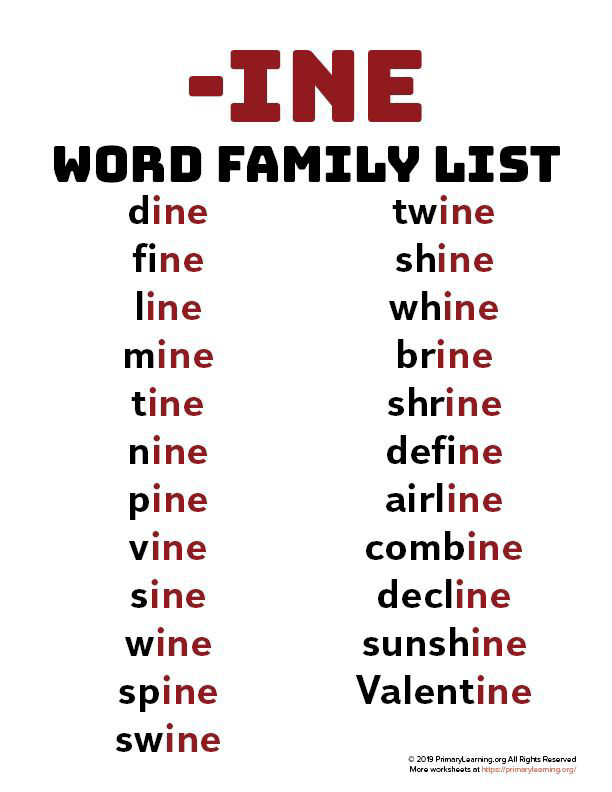
    Ending of the building words
    Beginning Blends


    For more information, send this to my 6360396463 no for whats Join Group

    ENGLISH GRAMMER - 02

    Active and passive voice:-

    Only TRANSITIVE VERB has two voices - Active and Passive Voices

    Subjects, Verb and Objects

    • Subjects - One who does an action.
    • Verb - Action is called verb.
    • Objects - One who is affected by the action of subject.

    Example
    • The teacher punished the boy.
    • Subject - teacher
    • Verb - punished
    • Object - boy

    The teacher punished the boy. (Active Voice)
    When this sentence is converted to passive voice the 'object' act as 'subject' and vice-versa.
    The boy was punished by the teacher. (Passive Voice)
    • Subject - boyTeacher
    • Verb - punished
    • Object - teacher

    Example
    • The dog bit the man. (Active Voice)
    • The man was bitten by the dog. (Passive Voice)

    I gave him a rupee. (Active Voice)
    A rupee was given to him by me. (Passive Voice)
    He was given a rupee by me. (Passive Voice)

    When Active Voice contains two object the passive voice can be written in 2 forms such as..

    Example
    • The teacher gave me two books. (Active Voice)
    • Two books were given to me by the teacher. (Passive Voice)
    • I was given two books by the teacher. (Passive Voice)

    Here 'two books'(Direct Object) and 'me'(Indirect Object) are the two objects.
    I gave him a rupee. (Active Voice)
    A rupee was given to him by me. (Passive Voice)
    He was given a rupee by me. (Passive Voice)
    If Active Voice contains 'Continous Form Of Verb(verb showing a continous action) then use 'being' with verb in Passive Voice

    Example
    • Juli is writing a letter. (Active Voice)
    • A letter is being written by juli. (Passive Voice)

    If Active Voice is in 'Perfect Tense' then use 'been' in Passive Voice

    Example
    • John has killed a snake. (Active Voice)
    • A snake has been killed by John. (Passive Voice)

    If Active Voice is in 'Future Tense' then use 'been' in Passive Voice

    Example
    • He will have brought some oranges. (Active Voice)
    • Some oranges will have been brought by him. (Passive Voice)
    __________________________________________
    Adverbials:-
    Adverbials modify or tell us something about the sentence or the verb. It may be a single adverb, a phrase, or a prepositional phrase, or clause element.

    When an adverbial modifies a verb, it changes the meaning of that verb.

    Example
    • The people looked at me.
    • The people looked at me anxiously. (The verb looked suddenly has a very different meaning).

    When an adverbial modifies a sentence, the meaning of the sentence changes.

    Example
    • I passed all of my exams.
    • Surprisingly, I passed all of my exams.

    Word groups that are also considered to be adverbials can also modify verbs: a prepositional phrase, a noun phrase, a finite clause or a non-finite clause.

    Multi-word adverbials are sometimes called adverbial phrases.

    Example
    • I ran as quickly as I could, but I missed the bus.

    If a whole clause acts as an adverbial, it's called an adverbial clause.

    Example
    • I'll go to bed when the film ends.
    __________________________________________
    Articles:-
    Adjective a,an the are called articles.

    Example
    • Everest,London,Mumbai,New york

    Type of Articles

    INDEFINITE ARTICLES

    'a or an' are indefinite articles and are used when to say about not a definite person, place or thing.

    Example
    • I saw a girl.(any girl --not definite)
    • He gave me an orange.

    DEFINITE ARTICLES

    'the' is called definite article and is used when to say about a definite person, place or thing.

    Example
    • I saw the girl who secured the first rank.(girl --is definite)

    Usage of Definite Articles

    'the' is used before the following common noun.
    Example
    • the sun, the moon, the planet, the sky, the earth

    'the' is used before a particular person or thing already referred to.
    Example
    • The boy whom I met yesterday.
    • The book that I gave you.

    'the' is used before some books.
    Example
    • The Ramayana
    • The Koran.
    • The Bible.

    'the' is used before name of rivers,mountain,seas,oceans,islands..etc.

    Example
    • The Ganges
    • The Nile.
    • The Laccadive.

    'the' is used before a singular noun that represents the whole class.

    Example
    • The cowis a domestic animal.
    • The rose smells sweet.
    • The parrotis a beautiful bird.

    'the' is used before superlatives.

    Example
    • The highest mountain in the world.
    • The best picture I have ever seen.

    'the' is not used before proper noun.

    Example
    • Mumbai is a major port in India.
    • Pacific is the deepest ocean.
    __________________________________________
    Capitalization:- means using a capital letter (for example, A instead of a). The use of capital letters helps readers read your writing without confusion.

    Always capitalize the following:

    The first word in a sentence.
    • I grew up in India.
    • S he left a message on my phone.
    The pronoun I.
    • This country is where I dreamed of.
    The first letter of a proper noun (specific name).
    • D avid wants to play soccer with us.
    • This letter is from C hang.
    • I graduated from the U niversity of N ew Y ork.
    • I like C oca- C ola.
    • She likes G odiva chocolates.
    The first letter of months, days, and holidays (but not seasons).
    • Today is J une 8, 2011.
    • Susie's birthday is this T hursday.
    • The shops are closed on E aster.
    • This summer is going to be very hot.
    The first letter of nationalities, religions, races of people, and languages.
    • We often eat I talian food.
    • I want to master many languages, such as S panish, K orean, C hinese, and R ussian.
    • There is one C hristian church in my town.
    The first letter in a person's title.
    • This is D r. Simon.
    • I got it from M r. Tom.
    Geographic areas: cities, states, countries, mountains, oceans, rivers, etc.
    • My destination is P aris, F rance.
    • Hawaii is in the middle of the P acific O cean.
    Historical periods.
    • The R enaissance began in the 14th century.
    • The Q ing D ynasty is the last dynasty in China.
    The first letter of each major word in the title of a book, movie, article, etc.
    • Tolstoy's W ar and P eace is my favorite novel.
    • I found the article " H ow to W rite a G ood C over L etter" in this magazine.

    Correctly write each sentence using proper Capitalization.

    1) i was born in shanghai, china, but grew up in the united states.
    2) mrs. ohana gave me the bible.
    3) if you walk two more blocks, you will be able to see mt. rocky.
    4) my family will have a summer vacation in hawaii.
    5) I didn't want to cook tonight, so I just ordered thai food for dinner.
    __________________________________________
    Cases:-

    Case is the grammatical function of a noun or pronoun. There are only three cases in modern English, they are subjective (he), objective (him) and possessive (his). They may seem more familiar in their old English form - nominative, accusative and genitive. There is no dative case in modern English.

    The pronoun cases only three:-

    • 1. Subjective case: pronouns used as subject.
    • 2. Objective case: pronouns used as objects of verbs or prepositions.
    • 3. Possessive case: pronouns which express ownership.

    PERSONAL PRONOUN

    Subjective/NominativeObjective/AccusativePossessive/Genitive
    Referring to the subject in a sentenceReferring to the object in a sentenceThe apostrophe form of the word ("Lynne's).
    IMeMine
    YouYouYours
    HeHimHis
    SheHerHers
    ItItIts
    WeUsOurs
    TheyThemTheirs
    WhoWhomWhose

    These pronouns, and who and its compounds, are the only words that are inflected in all three cases (subjective, objective, possessive). In nouns the first two cases (subjective and objective) are indistinguishable, and are called the common case. One result of this simplicity is that, the sense of case being almost lost, the few mistakes that can be made are made often, even by native speakers, some of them so often that they are now almost right by prescription.

    __________________________________________
    Common mistakes (confused words)
    1 Accept ,Except
    The words, 'accept' and 'except' are homophones which are often confused by English speakers. 'Accept' is a verb which means 'to receive' or 'to agree'. Most of the time 'except' is used as a preposition which means 'excluding'.


    The following examples will make the usage clear.

    Accept (VERB)Except (PREPOSITION)

    Amit accepted the job offer.

    I can come with you on all days except Sunday.

    Sanjiv accepted the allegation that he had cheated.

    All the athletes except Anjali finished the race.

    He accepted the invitation to the party.

    Everyone except Shantanu was invited to the party.

    __________________________________________
    2. Bought, Brought

    The difference between these two words is a very simple one. They are the past tenses of two different verbs.

    'Bought' is the past tense of 'buy'.

    Example
    • I bought a new car last week.

    'Brought' is the past tense of 'bring'

    Example
    • I brought him a glass of water.

    The difference can be remembered easily too, as 'bring' shares its first two letters with 'brought' ('br').

    __________________________________________

    3.Can , May

     Many English speakers are confused about the usage of the words 'can' and 'may'. For e.g., 'Can I drink water?' is incorrect. 'May I drink water?' is the correct phrase to use in this case.


    The key difference between 'can' and 'may' is that 'can' talks about ability and 'may' talks about permission.

    CAN

    Can is used in two cases:

    To talk about ability.


    Example
    • I can finish my homework by 5 pm.
    • Can you finish your homework tonight?

    To ask or give permission informally.


    Example
    • Can I use your pen? (To a friend)
    • You can use my pen. (To a friend)

    MAY

    May is generally used to ask or give permission formally.

    Let us take a situation between a student and a teacher.


    Example
    • May I drink water?
    • Teacher: Yes, you may.

    Let us take a situation between two strangers.

    Example
    • May I borrow your pen?
    • Yes, you may.

    __________________________________________

    4. Affect, Effect

    Two words commonly confused by English speakers are 'effect' and 'affect'. 'Affect' is used as a verb and means 'to have an influence on' and 'Effect' is used as a noun and means 'the result'.

    AFFECT


    Example
    • The dropped catch did not affect the result of the game.
    • The heavy rainfall affected the grains kept in the old warehouse.

    EFFECT


    Example
    • The effect of the tsunami was devastating.
    • The side effect of the cough syrup was drowsiness.

    __________________________________________

    5. Have, Has

    'Have' and 'has' are both used to denote possession, form the perfect tense, and the past tense of both is 'had', but they are used differently.

    Have

    'Have' is used with the following pronouns: I, you, we, they.

    Example
    • I have a pencil.
    • We have a big house.

    Pluralised nouns

    Example
    • Doctors have a rough time, dealing with illnesses all the time.

    Has

    'Has' is used with the third person singular ( he, she, it) .

    Example
    • She has your money.
    • Amit has the book.

    _________________________________________

    6. There, Their, They're

    Many speakers tend to get confused between 'There', 'Their' and 'They're' and knowing how to use these three words correctly is an important step in learning English.

    The words 'There' and' Their' are homophones. Homophones are words that are spelt differently but pronounced the same. It is a common mistake to replace one for the other.

    'There' always refers to a place, whether concrete or abstract, whereas 'Their' shows belonging or possession. 'They're, on the other hand, is the short form of they are

    Let's look at these examples for each of them

    THERE

    Example
    • How can anyone live there?
    • Let's go there.
    • There will be a party tomorrow,

    THEIR

    Example
    • Let us buy their car.
    • Let us not go to their house.
    • Return their books tomorrow.

    THEY'RE

    Example
    • They're sitting there in their car.

    In this sentence, notice how 'there' is used to signify a place whereas 'their' is used to show possession. The word 'they're' is a contraction of the word 'they' and 'are' and should not be confused with 'their' and 'there'.

    ✍️T. A Chandrashekhar

    Sunday, 16 May 2021

    English Grammar No- 01


    What is Grammar ?

    Science that deals with correct use of language both in conversation and writing.

    Sentence

    Group of words which makes complete sense.

    Example
    • The Earth goes around the sun.
    • Where do you come from ?

    Phrase

    Group of words which makes sense but not complete sense.They have no subject or predicateof their own.

    Example
    • in search of.
    • as soon as possible.

    Clause

    Group of words which forms part of a sentence, and contains a subject and a predicate.

    Example
    • The man whom I hate.
    • While it is raining.

    TypesOf Sentences

    Statements or Assertion
    A sentence that makes a statement or assertion.


    Example
    • The sun rises in the east.
    • The cow eats grass.

    INTERROGATIVE SENTENCE

    A sentence that asks a question.

    Example
    • Why did you go there ?
    • How old are you ?

    IMPERATIVE SENTENCE

    A sentence which expresses a command, a requestor or a wish.

    Example
    • Get out of the class.
    • sit down

    EXCLAMATORY SENTENCE

    A sentence which expresses a sudden, strong feeling.

    Example
    • How beautiful the sky is!
    • What a fine morning!
    __________________________________________
    PARTS OF SPEECH:-
    Word used as name of a person, place or thing.
    There are 8 kinds of Parts speech in English language
    📚 Noun
    📚 Pronoun
    📚 Verb
    📚 Adverb
    📚 Adjective
    📚 Conjunction
    📚Preposition
    📚 Interjection

    Example
    • Everest, London, Mumbai, New york

    Type of Nouns

    PROPER NOUNS

    Word used as name of a particular person, place or thing.

    Example
    • Everest, London, Mumbai, New york

    COMMON NOUNS

    Name given in common to every person or thing of same class or kind.

    Example
    • boy, tree, horse, king, town

    COLLECTIVE NOUNS

    Name of a group of person or things taken as a single whole.

    Example
    • crowd, army, team, family, assembly, committee

    ABSTRACT NOUNS

    Name of quality, state or action of a person or thing.

    Example
    • Goodness, kindness, slavery, poverty, laughter, theft, childhood

    MATERIAL NOUNS

    Name of materials out of which things are made.

    Example
    • gold, wood, stone, iron, wool, bronze, clay.
    __________________________________________
    PRONOUN

    Pronoun is the word used instead of a noun.

    Example
    • Harry is a good boy.He rises early in the morning.( 'He' is the pronoun used instead of Harry.)
    • him, he, she, it, my, mine, our, we, ours.. etc

    Type Of Pronouns

    PERSONAL PRONOUNS

    PERSONSINGULAR NUMBERPLURAL NUMBER
    First Person
    Imy
    mine
    me
    Weour
    ours
    us
    Second Person
    Youyour
    yours
    you
    Youyour
    yours
    you
    Third Person
    Masculine Gender
    Feminine Gender
    Neuter Gender
    He
    She
    It
    his
    her
    hers
    its
    him
    her
    it
    All Genders
    they
    they
    they
    their, theirs
    their, theirs
    their, theirs
    them
    them
    them

    First Person stands for the person speaking.
    Second Person stands for the person spoken to.
    Third Person stands for any one or anything.

    INTERROGATIVE PRONOUNS

    Interrogative pronouns are used for asking questions.

    Example
    • Who are you ?
    • who, what, which, whom, whose.. etc

    RELATIVE PRONOUNS

    Words such as who, what, which, that ..etc are called relative pronouns since they expresses relation between two sentences or phrases.

    Example
    • I saw an old man.He was too weak to walk.
    • I saw an old man who was too weak to walk.(who is the relative pronoun added to above sentence)
    • This is what I expected.
    __________________________________________
    VERB
    A verb is a word which tells us what a person or a thing is doing ; Verb shows an action.

    Example
    • The girl eats mangoes.
    • John is telling a story.
    • eat, tell, play, run, write, open, kill...

    Type of Verb

    TRANSITIVE VERB

    A verb which has an object is called a Transitive verb. Some time transitive verb may have two objects.

    Example
    • The cow gives us milk.
    • The cow gives us -what?-- milk
    • To whom ? us

    INTRANSITIVE VERB

    A verb which has no object is called a Intransitive verb.

    Example
    • He plays only on sundays.
    • He fought bravely.
    __________________________________________
    ADVERB

    An adverb is a word which modifies the meaning of a Verb, an Adjective or another Adverd.

    Example
    • The old man walked slowly .
    • Juli writes very carefully .
    • He works hard from dawn to night.

    Type of Adverbs

    ADVERB OF TIME

    If a verb answers for question 'When' then the adverb shows the time of action.

    Example
    • He left the place a few minutes ago.
    • He will soon come back.

    ADVERB OF PLACE

    If a verb answers for question 'Where' then the adverb shows the place of action.

    Example
    • I met him in the theatre.
    • This is the place where the tree stood.

    ADVERB OF NUMBER

    If a verb answers for question 'How often' then the adverb shows the number of the action.

    Example
    • The comet appears once in several years.
    • That poor man is always happy

    ADVERB OF MANNER

    If a verb answers for question 'How' or'In what manner' then it shows the condition of verb.

    Example
    • He was seriously injured.
    • Johny writes very carefully.

    ADVERB OF DEGREE or QUANTITY

    If a verb answers for question 'How much' or'In what'.

    Example
    • The sky is very cloudy.
    • She sings pretty well.

    ADVERB OF REASON

    If a verb explains the reason for the action then called adverb of reason.

    Example
    • As he was not well.
    • Therefore he returned home.
    __________________________________________
    ADJECTIVE
    Word that qualifies a noun and points out the quality,number or kind of the person, place or thing represented by the noun.

    Example
    • John is a clever boy.
    • Uncle gave me a beautiful watch.
    • sweet, blue, good, bad, tall, short...

    Type of Adjectives

    ADJECTIVES OF QUALITY

    Shows the kind or quality of a person or thing.

    Example
    • He is an honest boy.
    • The elephant is black.
    • old, young, clever, wise, tall, short..

    ADJECTIVES OF QUANTITY

    Shows how much of a thing is meant.

    Example
    • He has lost all his wealth.
    • I have enough clothes.
    • any,little, some...

    ADJECTIVES OF NUMBER

    Shows how many person or things are meant.

    Example
    • I have two brothers.
    • Only a few students failed.
    • many, all, several...

    DEMONSTRATIVE ADJECTIVES

    They point out which person or thing is meant.

    Example
    • The boy is taller than Alex.
    • These mangoes are sweet .
    • beautiful, that, such...

    INTERROGATIVE ADJECTIVES

    What,which,whose..etc : when they are used with nouns to ask questions.
    Example
    • What kind of animal is this?
    • Whose book is this?
    __________________________________________
    CONJUNCTION

    A conjunction is a word which joins together words or sentences.

    Example
    • And, as, but, before, after, if, whether, than, when, that, though, for, yet, why, unless, while, lest ..etc.

    Types Of Conjunction

    PHRASE CONJUNCTIONS

    When phrase used as conjunction they are called Phrase Conjunction.

    Example
    • As soon as he saw his father,he threw the cigarette away.
    • She appeared on the scene as if she were a princess.
    • It seems as though it is going to rain.
    • The teacher as well as his student was injured.
    • This is fully correct as far as I am concerned.
    • I would not do that even if he gave thousands of rupees.
    • I worked hard so that I might get a first class.

    CO-ORDINATING CONJUNCTIONS

    A conjunction that joins together sentences, clauses or words of equal rank, is called a CO-ORDINATING CONJUNCTION.

    Example
    • and, but, for, also, or, nor, so, yet,either..or, neither..nor
    • The idol is made of bronze and the toy is made of wood.
    • Please,take coffee or tea.
    • Do or die.

    SUBORDINATING CONJUNCTIONS

    A conjunction that joins a clause to the main clause in a sentence SUBORDINATING CONJUNCTION.

    Example
    • after, before, because, if, whether, when, where, how,while, that, though,although, as, unless,till
    • He was absent because he was ill.
    • Strike when the iron is hot.

    Some Conjunction Come In Pairs

    Example
    • He is either a begger or a theif.
    • She is neither my sister nor my niece.
    • Not only I like mangoes, but also apples.
    • Though he is poor, yet he helps the needy.
    • She is both, pretty and clever.
    • Whether they bring it or not is uncertain.
    • Milton was not a politician but a poet.
    • No sooner did I see him than I saluted him.
    • Scarely had the rain stopped when I went out.
    __________________________________________
    PREPOSITION
    A preposition is a word placed before a Noun or Pronoun to show its relation to some other word in the sentence.

    Example
    • The clock is on the wall.
    • The cow is grazing in the field.
    • He is angry with you.

    Sample Usage of Some Prepositions

    BETWEEN and AMONG

    While saying about two person or thing we use BETWEEN and while saying about more than two person or thing we use AMONG.

    Example
    • Two brothers shared the apple between themselves.
    • I sat between Ancy and Juli.

    BESIDE and BESIDES

    Beside means by the side of.
    Besides means in addition to.

    Example
    • My house is beside the river.
    • He plays football besides badminton.

    BY and WITH

    When we say about a person who does the action we use BY.
    When to say about some thing near by,or some thing along with weuse WITH.

    Example
    • A snake was killed by the boy.
    • I am writing with my pen.

    IN and AT

    IN is used along with countries, placec cities .. etc.
    AT is used along with names of towns, small villages .. etc.

    Example
    • My brother lives in America.
    • The classes will begin at 10 A.M.

    • NOTE : Sometimes IN is also used to indicate 'Period of Time'. He came in time.

    ON and UPON

    When we say about some thing at rest we use ON.
    When we say about some thing that is not at rest we use UPON.

    Example
    • The clock is on the wall.
    • The tiger sprang upon a deer.
    __________________________________________
    INTERJECTION
    A word which expresses a sudden feeling.

    Example
    • Hurrah ! We have won the match.
    • Alas ! she is dead.
    • Oh ! it was horrible.
    __________________________________________

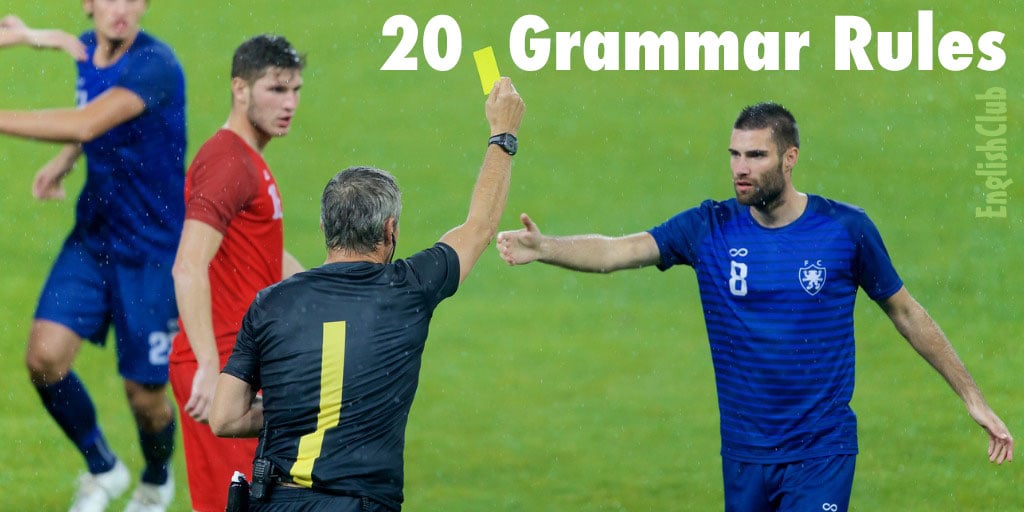
    20 Grammar Rules

    rules of the game - football or grammar

    Here are 20 simple rules and tips to help you avoid mistakes in English grammar. For more comprehensive rules please look under the appropriate topic (part of speech etc) on our grammarand other pages.

    1. A sentence starts with a capital letter and ends with a period/full stop, a question mark or an exclamation mark. see Punctuation

    • The fat cat sat on the mat.
    • Where do you live?
    • My dog is very clever!

    2. The order of a basic positive sentence is Subject-Verb-Object. (Negative and question sentences may have a different order.)

    • John loves Mary.
    • They were driving their car to Bangkok.

    3. Every sentence must have a subject and a verb. An object is optional. Note that an imperative sentence may have a verb only, but the subject is understood.

    • John teaches.
    • John teaches English.
    • Stop! (i.e. You stop!)

    4. The subject and verb must agree in number, that is a singular subject needs a singular verb and a plural subject needs a plural verb.

    • John works in London.
    • That monk eats once a day.
    • John and Mary work in London.
    • Most people eat three meals a day.

    5. When two singular subjects are connected by or, use a singular verb. The same is true for either/or and neither/nor.

    • John or Mary is coming tonight.
    • Either coffee or tea is fine.
    • Neither John nor Mary waslate.

    6. Adjectives usually come before a noun (except when a verb separates the adjective from the noun).

    • I have a big dog.
    • She married a handsome Italian man.
    • (Her husband is rich.)

    7. When using two or more adjectives together, the usual order is opinion-adjective + fact-adjective + noun. (There are some additional rules for the order of fact adjectives.)

    • I saw a nice French table.
    • That was an interesting Shakespearian play.

    8. Treat collective nouns (e.g. committee, company, board of directors) as singular OR plural. In BrE a collective noun is usually treated as plural, needing a plural verb and pronoun. In AmE a collective noun is often treated as singular, needing a singular verb and pronoun.

    • The committee are having sandwiches for lunch. Then they will go to London. (typically BrE)
    • The BBC have changed theirlogo. (typically BrE)
    • My family likes going to the zoo. (typically AmE)
    • CNN has changed its logo. (typically AmE)

    9. The words its and it's are two different words with different meanings.

    • The dog has hurt its leg.
    • He says it's two o'clock.

    10. The words your and you're are two different words with different meanings.

    • Here is your coffee.
    • You're looking good.

    11. The words there, their and they're are three different words with different meanings.

    • There was nobody at the party.
    • I saw their new car.
    • Do you think they're happy?

    12. The contraction he's can mean he is OR he has. Similarly, she's can mean she is OR she has, and it's can mean it is OR it has, and John's can mean John isOR John has.

    • He is working
    • He has finished.
    • She is here.
    • She has left.
    • John is married.
    • John has divorced his wife.

    13. The contraction he'd can mean he had OR he would. Similarly, they'd can mean they had OR they would.

    • He had eaten when I arrived.
    • He would eat more if possible.
    • They had already finished.
    • They would come if they could.

    14. Spell a proper noun with an initial capital letter. A proper noun is a "name" of something, for example Josef, Mary, Russia, China, British Broadcasting Corporation, English.

    • We have written to Mary.
    • Is China in Asia?
    • Do you speak English?

    15. Spell proper adjectives with an initial capital letter. Proper adjectives are made from proper nouns, for example Germany → German, Orwell → Orwellian, Machiavelli → Machiavellian.

    • London is an English town.
    • Who is the Canadian prime minister?
    • Which is your favourite Shakespearian play?

    16. Use the indefinite article a/anfor countable nouns in general. Use the definite article the for specific countable nouns and all uncountable nouns.

    • I saw a bird and a balloon in the sky. The bird was blue and the balloon was yellow.
    • He always saves some of the money that he earns.

    17. Use the indefinite article awith words beginning with a consonant sound. Use the indefinite article an with words beginning with a vowel sound. see When to Say a or an

    • a cat, a game of golf, a human endeavour, a Frenchman, a university (you-ni-ver-si-ty)
    • an apple, an easy job, an interesting story, an old man, an umbrella, an honorable man (on-o-ra-ble)

    18. Use many or few with countable nouns. Use much/a lotor little for uncountable nouns.see Quantifiers

    • How many dollars do you have?
    • How much money do you have?
    • There are a few cars outside.
    • There is little traffic on the roads.

    19. To show possession (who is the owner of something) use an apostrophe + s for singular owners, and s + apostrophe for plural owners.

    • The boy's dog. (one boy)
    • The boys' dog. (two or more boys)

    20. In general, use the active voice (Cats eat fish) in preference to the passive voice (Fish are eaten by cats).

    • We use active in preference to passive.
    • Active is used in preference to passive.
    __________________________________________
    T.A Chandrashekhar 6360396463

    PRESNENT TENSE

    Unit Test: Present Tense Choose the correct answer. 1 of 10 I ____ in a bank. works working work is working 2 of 10 Barbara ____ everyday. r...